AI-Assisted Customization of 3D-Printed Biomaterials
Interactive platform for ML-driven bioprinting parameter optimization
Overall classification accuracy on test set
Total bioprinting trials in dataset
28% relative importance in model
Referenced research papers
3D bioprinting builds tissue-engineered constructs by depositing bioinks in precise geometries. However, balancing bioink formulation, extrusion settings, and cell viability is challenging: slight shifts in one parameter (e.g., viscosity, pressure, temperature) can drastically affect outcomes. Traditional trial-and-error approaches are laborious and low-throughput, often requiring dozens of manual experiments to identify workable settings for a single bioink–cell combination.
Machine learning offers a powerful solution by learning from a limited set of well-controlled experiments to predict outcomes across untested parameter combinations. This dashboard presents a supervised-learning framework for bioprinting optimization using a Random Forest classifier to predict cell viability categories.
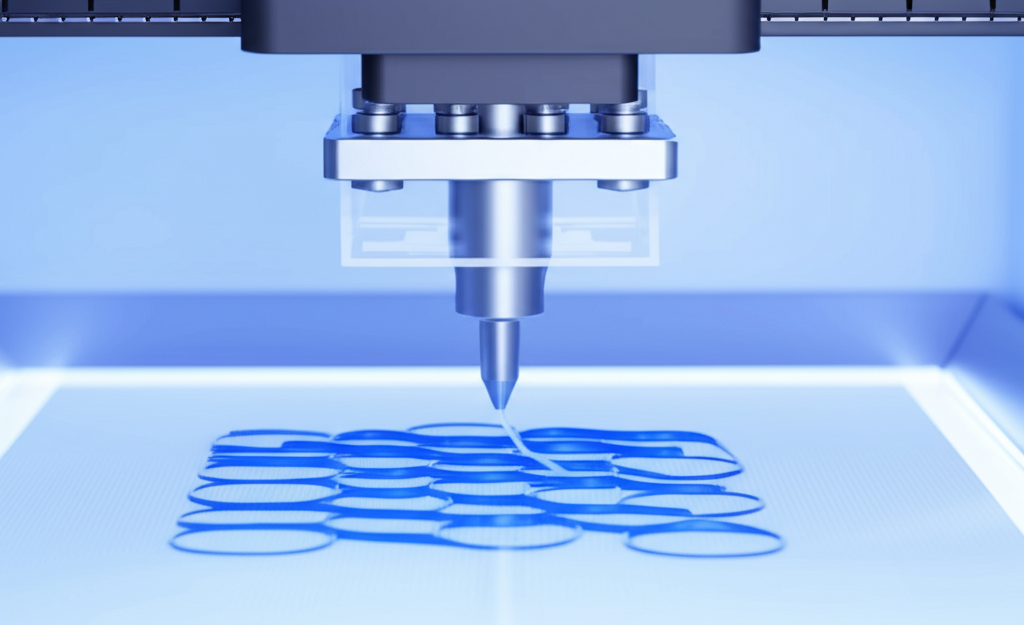
Extrusion-Based Bioprinting
A continuous filament of bioink is deposited layer by layer through a nozzle.
- • Can handle high-viscosity inks and high cell densities
- • Suitable for scaffolds with mechanical strength
- • Lower resolution (~100 µm)
- • Cells experience shear stress in the nozzle
Bioink Composition
2% w/v alginate, 5% w/v gelatin hydrogel
Sample Size
150 total prints (120 training, 30 testing)
Parameters Varied
- • Nozzle temperature: 180–210 °C
- • Print speed: 20–40 mm/s
- • Cell density: 5–15 ×10⁶ cells/mL
- • Viscosity: 2–4 Pa·s
- • Layer height: 0.2–0.4 mm
- • Crosslink time: 30–60 s
Evaluation Method
Live/dead fluorescent staining and structural integrity assessment
Future Directions
Equip bioprinters with real-time sensors and integrate defect-detection algorithms for automatic parameter adjustment.
Build hybrid simulators coupling fluid dynamics with ML surrogate models for virtual parameter testing.
Develop an open repository for labs to upload print settings and outcomes, enabling robust cross-material meta-models.